


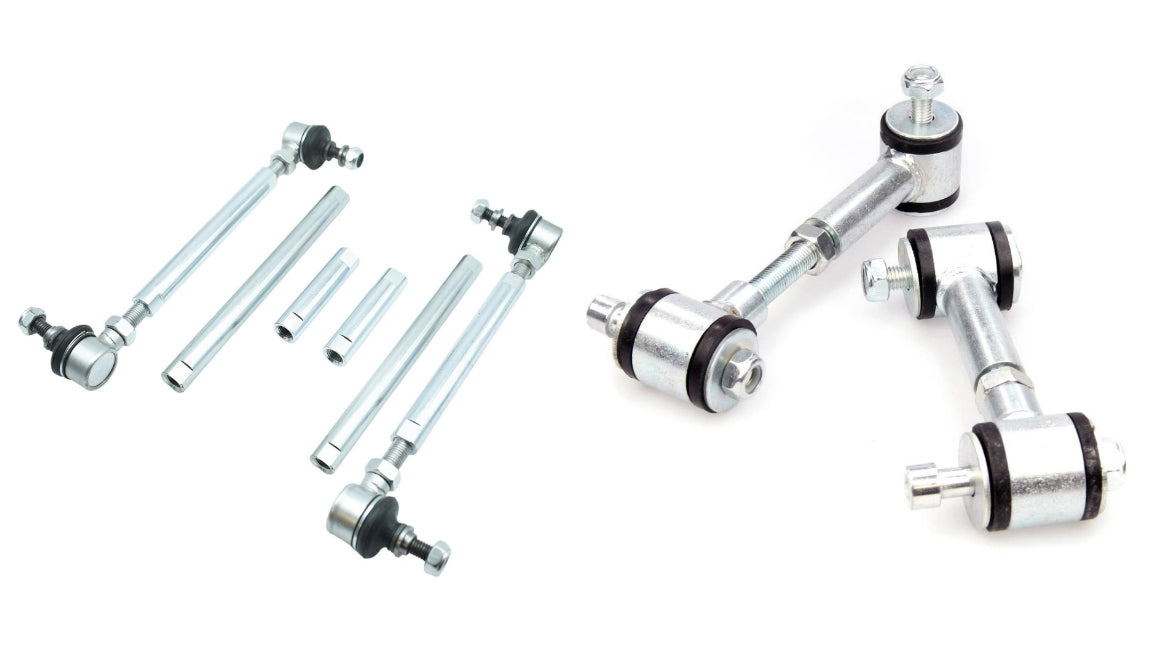
One of the most common questions when fitting coilovers is whether shorter drop links are also required. The answer depends on the vehicle, its suspension design and how far it is being lowered.
Some cars can retain their original drop links with a modest reduction in ride height. However, when a vehicle is lowered more significantly—often by approximately 40mm or more—shorter drop links may be needed to position the anti-roll bar correctly and prevent clearance problems or unwanted preload.
Adjustable drop links provide a more flexible solution because their length can be set to suit the vehicle’s final ride height and suspension setup.
What does a drop link do?
A drop link connects the vehicle’s anti-roll bar to the suspension. As the car corners, the anti-roll bar helps control the difference in movement between the left and right sides of the suspension, reducing excessive body roll.
Although a drop link is a relatively small component, its length and installation angle are important. When the suspension height changes significantly, the original drop link may no longer hold the anti-roll bar in a suitable position.
Why might shorter drop links be needed with coilovers?
Lowering a car changes the resting position and geometry of several suspension components. If the original fixed-length drop links are retained after a substantial reduction in ride height, they can sometimes hold the anti-roll bar at an unsuitableuitable angle or cause it to contactcontact nearbyune with nearbyunexpected nearbyanother. Contact
A shorter drop link can help reposition the anti-roll bar aftereveryone towards a more suitable operating position on a lowered vehicle.
Shorter drop links may be required when:
- The vehicle has been lowered by approximately 40mm or more.
- The original drop links are too long for the new suspension position.
- The drop link or anti-roll bar contacts a driveshaft, wishbone orbones or anotherother componentcomponents.
- The mounting bolts cannot be aligned without applying force.
- The coilover manufacturer recommends shortened drop links.
The exact requirement varies between vehicles, so there is no single drop-link length that works for every lowered car.
What is anti-roll-bar preload?
If a drop link is not the correct length for the new ride height, it can pull or push against the anti-roll bar while the vehicle is sitting level.
This is known as anti-roll-bar preload. It means the anti-roll bar is already being twisted or loaded before the car enters a corner or passes over an uneven road surface.
Possible symptoms of an unsuitableunsuitable drop-link setup can include:
- KnKnocking or clunking from the suspension.
- Difficulty aligning the drop-link bolts during installation.
- Contact between the drop link, anti-roll bar or nearby suspension components.
- Uneven suspension response from one side of the vehicle to the other.
- Premature wear to the drop-link joints or bushes.
These symptoms can have several other causes, so the complete suspension should always be inspected before assuming the drop links are responsible.
Shortened vs adjustable drop links
A shortened drop link has a fixed length selected to suit a lowered suspension setup. This can work well when the required replacement length is already known.
An adjustable drop link allows the effective length to be altered. This makes it possible to set the link for the vehicle’s actual ride height rather than relying on one predetermined length.
Adjustable drop links are particularly useful when:
- The coilover ride height may be changed later.
- The required drop-link length is not known in advance.
- Different lowering heights are available from the same coilover kit.
- The owner wants to set the links without unwanted anti-roll-bar preload.
The purpose is not simply to adjust the links to their shortest possible setting. They should be set to the length required for the mounting bolts to align naturally while the car is resting at its normal ride height.
How should adjustable drop links be set up?
The following is a general guide. Always follow the instructions supplied with the suspension and use the vehicle manufacturer’s torque specifications where available.
- Fit the coilovers and complete the initial installation.
- Set the desired ride height on both sides of the vehicle.
- Place the car on level ground with its normal weight supported by the wheels or suspension.
- Adjust the drop-link length so the mounting bolts slide through naturally, without using force or levering the anti-roll bar.
- Check that the links have sufficient clearance throughout the suspension and steering movement.
- Hold the ball-joint pin correctly while tightening so it does not rotate.
- Tighten the mounting fixings and adjustment lock nuts securely.
- Recheck the installation after the suspension has settled.
Never use an adjustable drop link to pull the anti-roll bar into position. If significant force is required to insert the bolts, the link length or suspension position must be checked.
Should adjustable drop links be the same length on both sides?
On a road car sitting level, the links will normally be set to the same effective length. The most important point is that they connect without loading the anti-roll bar while the vehicle is at its normal resting height.
Before adjusting the links, make sure the coilover ride heights are set correctly and that the vehicle is standing on level ground with even tyre pressures and normal vehicle loading.
M10 and M12 mounting holes
Some adjustable drop-link kits use M10 fixings but can also be fitted to suspension components with M12 mounting holes by using the correct reducing shims.
- M10 mounting holes: fit the drop links without the reducing shims.
- M12 mounting holes: install the supplied shims so the M10 fixing is correctly located.
Using the correct hardware prevents unwanted movement in the mounting hole and helps the drop link remain securely positioned.
Can I use standard drop links with coilovers?
In many cases, yes. If the vehicle is only being lowered moderately and the original drop links fit naturally without preload or clearance problems, they may still be suitable.
Shorter or adjustable drop links should be considered if the standard links:
- Cannot be installed without applying force.
- Cause the anti-roll bar to sit at an unsuitable angle.
- Make contact with nearby components.
- Create unwanted preload at normal ride height.
- Are not suitable for the amount of lowering required.
Choosing the correct adjustable drop links
The required drop-link length should ideally be measured between the mounting points with the vehicle set at its finished ride height.
Stanced UK offers adjustable drop-link kits covering different length ranges, including options suitable for many lowered Audi, BMW, MINI, SEAT, Skoda and Volkswagen models.
Browse our adjustable drop links or contact us with your registration, vehicle model, current suspension and intended lowering height if you need help choosing the correct option.
Shorter drop links and coilovers: frequently asked questions
Do I always need shorter drop links with coilovers?
No. Some vehicles can retain their standard drop links, particularly when the car is only being lowered moderately. The correct choice depends on the suspension design, lowering height and available clearance.
How much lowering requires shorter drop links?
Shorter or adjustable drop links are commonly considered when lowering a vehicle by approximately 40mm or more. However, this is only a general guide and the requirement varies between vehicles.
Are adjustable drop links better than fixed shorter links?
Adjustable drop links offer greater flexibility because their length can be set to suit the vehicle’s finished ride height. Fixed shorter links can still work well when the correct required length is already known.
Will shorter drop links lower my car?
No. The coilovers or lowering suspension determine the vehicle’s ride height. Shorter drop links are used to help position the anti-roll bar correctly after the suspension height has changed.
Can incorrectly adjusted drop links cause knocking?
Yes. Incorrect length, loose lock nuts, worn joints, unsuitable mounting hardware or contact with another component can all contribute to suspension noises.
When should adjustable drop links be set?
Set the final coilover ride height first. The adjustable drop links should then be set with the suspension supporting the vehicle at its normal resting position.
