


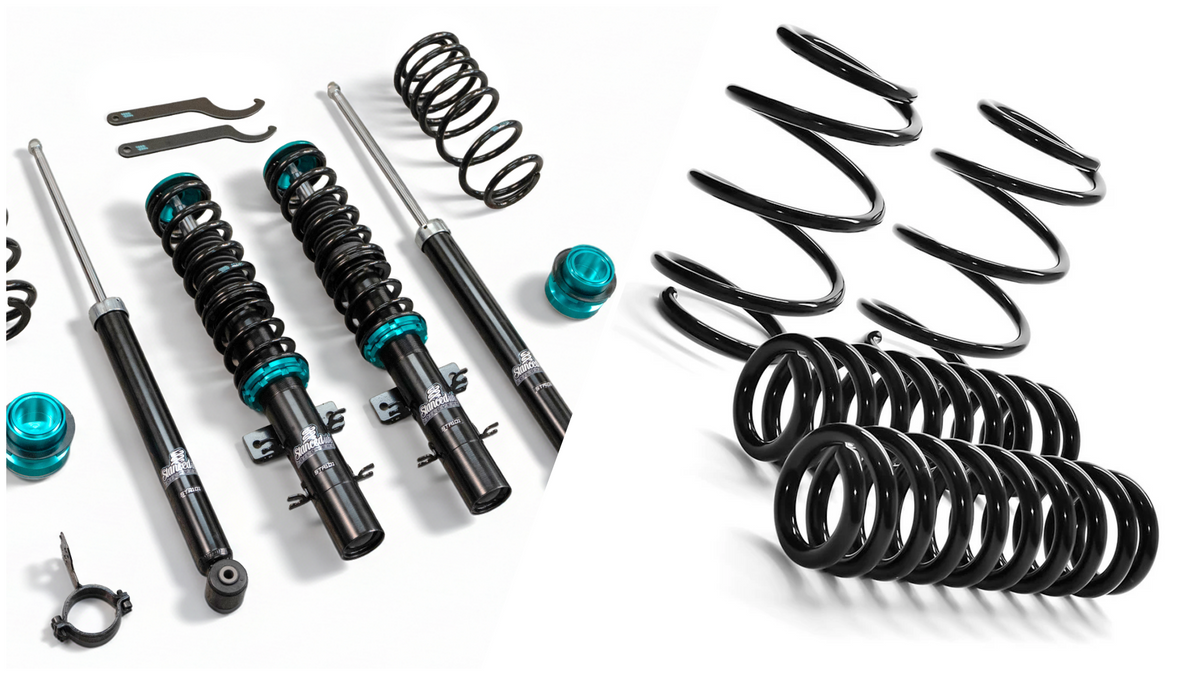
Lowering springs and coilovers are two of the most popular ways to lower a car, but they achieve the result in different ways. The right option depends on how much you want to lower the vehicle, whether you want adjustable ride height and how you use the car.
In this guide, we compare coilovers vs lowering springs to help you choose the most suitable suspension setup for your car.
What are lowering springs?
Lowering springs replace the car’s original springs while normally retaining the standard shock absorbers. They are shorter than the original springs and are designed to reduce the vehicle’s ride height by a predetermined amount.
Depending on the vehicle and spring kit, the advertised reduction might be approximately 20mm, 30mm or 40mm. Once fitted, that lowering amount cannot normally be adjusted.
Lowering springs are often chosen by drivers who want a modest drop without replacing the complete suspension system. However, the condition and suitability of the existing shock absorbers must also be considered. Worn standard shocks can affect ride quality and suspension control, while a large drop may operate the shocks outside their ideal working range.
What are coilovers?
Coilovers replace more of the original suspension assembly and combine matched springs and dampers in a height-adjustable package. On most road coilover kits, threaded spring platforms or adjustable lower mounts allow the ride height to be changed after installation.
This gives you more control over how the car sits. Rather than being restricted to the fixed drop provided by lowering springs, coilovers allow the ride height to be set within the adjustment range of the specific kit.
The Stanced UK Tuner Series coilover range is designed for drivers who want adjustable ride height, a more controlled feel and a purposeful lowered appearance without moving into the price range of competition suspension.
Coilovers vs lowering springs: the main differences
Ride-height adjustment
Lowering springs provide a fixed reduction. Coilovers allow the vehicle’s ride height to be adjusted within the range provided for that application.
This adjustability is useful when trying to achieve a particular stance, balance front and rear arch gaps or create additional clearance for different wheels and tyres.
Springs and dampers
With lowering springs, the factory dampers are normally retained. Coilover kits provide springs and dampers designed to work together as a complete setup.
Replacing the complete assembly can be particularly worthwhile on an older vehicle where the original dampers are already worn.
Ride and handling
Both options can make a car feel firmer than standard. The final result depends on the quality of the components, the amount of lowering, tyre choice, wheel size, suspension condition and correct installation.
A well-matched coilover kit can provide more controlled body movement and a more direct driving feel. However, setting any car excessively low reduces available suspension travel and can make the ride harsher.
Cost
Lowering springs generally have a lower initial purchase price. However, if the existing dampers need replacing at the same time, the overall cost difference can become much smaller.
Coilovers cost more than a basic spring kit but include replacement dampers and offer adjustable ride height. This can make them better value for drivers who want more than a small, fixed drop.
Installation and alignment
Both lowering springs and coilovers should be fitted correctly, with all fixings tightened to the vehicle manufacturer’s specifications. A full wheel alignment should be carried out after the suspension has settled and whenever the ride height is changed significantly.
Are coilovers better for achieving a particular stance?
Coilovers are normally the better choice when appearance and ride height are important. Their adjustment range allows you to fine-tune the position of the car rather than accepting the single fixed height produced by lowering springs.
Remember that the quoted lowering range is normally measured against the vehicle’s original factory ride height. Older factory springs may already have sagged, so the visual difference can sometimes be smaller than expected.
Wheel and tyre clearance must also be checked throughout the steering and suspension travel. Depending on the wheel offset and tyre size, wheel spacers or other adjustments may sometimes be required to provide adequate clearance between the wheel and coilover body.
Are lowering springs better for a small drop?
If you only want a subtle, fixed reduction and the original dampers are in excellent condition, lowering springs may be sufficient. They can offer a straightforward way to reduce arch gap while retaining much of the original suspension.
The limitation is that you cannot fine-tune the height afterwards. If the finished stance is higher or lower than expected, changing it normally means purchasing another spring kit.
Are coilovers suitable for daily driving?
Yes, road-focused coilovers can be used on a daily-driven car when they are installed and set up correctly. Sensible ride height is important: lowering the vehicle to the point where suspension travel is severely restricted will compromise comfort and usability regardless of the brand fitted.
For everyday road use, the goal should be a controlled lowered stance with enough ground clearance and suspension travel for the roads you regularly drive.
Which option should you choose?
Choose lowering springs if:
- You want a modest, fixed drop.
- Your existing dampers are in good condition.
- Height adjustment is not important.
- The lowest initial purchase price is your priority.
Choose coilovers if:
- You want adjustable ride height.
- You want to replace the springs and dampers together.
- You want greater control over the finished stance.
- You may change wheels, tyres or ride height later.
- You want a firmer, more controlled road setup.
For drivers looking for adjustable ride height and a matched suspension package, explore our Stanced UK coilover kits. Our team can also help confirm the correct kit for your vehicle before you order.

Coilovers vs lowering springs: frequently asked questions
Do coilovers replace the shock absorbers?
In most applications, yes. A coilover kit supplies matched dampers and springs to replace the relevant original suspension components. The exact contents vary by vehicle.
Can lowering springs be adjusted?
No. Conventional lowering springs provide a fixed reduction in ride height. Coilovers are required if you want to alter the height after installation.
Do I need wheel alignment after fitting coilovers or lowering springs?
Yes. Changing the ride height can alter wheel alignment. Allow the suspension to settle and then have the alignment checked and adjusted by a professional.
Will coilovers make my car uncomfortable?
Coilovers are normally firmer than standard suspension, but the ride should remain usable when a road-focused kit is fitted correctly and the car is not set excessively low.
Do I need adjustable drop links after lowering my car?
They may be required on some vehicles, particularly with larger ride-height reductions. Adjustable drop links allow the anti-roll bar to be connected without unwanted preload. See our complete adjustable drop-link guide for more information.
